The Divine in Music
In the words of the renowned scholar Dr.V.Raghavan,
“The age of Chaturdandi, of Gita, Prabandha, Thaya and Alapa had to give place to the age of Pada, Kirtana and Krithi. In achieving this, Thyagaraja stands foremost with his marvellous contribution… in sheer volume of output, he essays in the direction of Purandara Dasa and Kshetragna; In devotion, religious fervour, reformatory zeal and spiritual realisation, his songs approach those of Purandara Dasa. When we think of him singing to his Rama in anguish, we find in him a second Ramadas of Bhadrachalam. In his lyrical moods he takes a page off Kshetragna; in the Pancharatnas and some of his heavier compositions, he treads the path of the earlier prabandha – karas and later varna- karas; in turning out pieces now and then in the language of the Gods, he seems to beckon his contemporary Dikshitar. When he sings of Mother Tripurasundari, it appears as if Shyama Shastri of Tanjore was sojourning at Tiruvotriyur; and he could sustain himself through the task of a dramatic composition like Narayana Tirtha or Merattur Venkatarama Bhagavatar and pay his homage to a sampradaya sanctified by Jayadeva”.
Saint Thyagaraja was born to teach humanity the path of salvation through Music and Ramabhakti. His contribution to the culture growth in south India is unique. He was a practical philosopher and one of the most stellar figures in the great Bhakti tradition of our land – great seers of our times, who wove spiritual instruction and life science into music, to teach and inspire millions, showing the path to salvation. He takes the prime place among the musician-saints of our country, like Kabir and Purandaradasa, the latter of whom exerted a very large influence on Thyagaraja, or the pioneers of devotional poetry in south India – the Alvars and the Nayanmars. Saint Thyagaraja’s compositions exhibit a holistic expression of the richest values in Carnatic Music – in raga, sahitya and composition structure. The hallmark of a typical Thyagaraja Kriti is that it glitters, inspires, sweeps, cajoles and conquers. He is a spiritual mentor, a guru and a never ending source of inspiration to lakhs of musicians, music lovers and other devotees even today.
Saint Thyagaraja Swamy is believed to be a divine re-incarnation of Narada Maharishi and Valmiki Maharishi. The musical treatise the Sage Narada gifted to Saint Thyagaraja according to tradition is the “Swararnava (or Svarārnavam, meaning Ocean of Musical tones).
Saint Thyagaraja, the musical genius and spiritually evolved poet-saint was born in Tiruvarur on 27th Chaitra, Sarvajitu, a Sukla Saptami corresponding to 4th May, 1767. He was the third son of Ramabrahmam, a distinguished Katha Kalakshepam exponent and specialist in Ramayana, who was patronised by the King of Thanjavur. His mother Seethamma was the daughter of the Asthana Vidwan Veena Kalahastayya.
The family shifted to Thiruviayaru where the saint spent the major part of his life and attained samadhi. He studied Sanskrit and Telugu and mastered Valmiki Ramayanam and other religious literature. He was introduced to the compositions of Sangita Pitamaha Sri Purandaradasa by his mother at a very early age and worshipped him as his Adiguru. He spent a year in tutelage of the court musician Sonti Venkataramanayya at the age of 16. After that he was on his own, perfecting his technique by immersing himself in the study of musicology from various treatises. While in his teens he composed his first song ‘Namo Namo Raghavaya’ in Desikatodi and inscribed it on the walls of the house. That was the beginning of a lifetime of creation of a compositional heritage that will inspire humanity for all of its existence.
In April 1839 he visited Tirupati, but when he reached, the temple was closed. In sadness, he sang ‘Teratiyagaraadaa’. The temple officials gathered in admiration when they saw the door open by itself and the screen fall aside. He sang ‘Venkatesha Ninnu Sevimpa’ in his happiness at seeing the Lord.
Innumerable such incidents of superhuman and divine nature dot the life of the saint. His compositional expression was a confluence of a muscial genius and divinity.
The Thyagaraja kriti is a virtual signature form of Carnatic music. Blessed are we that we continue to hear, study and sing these manifestations of divine inspiration.
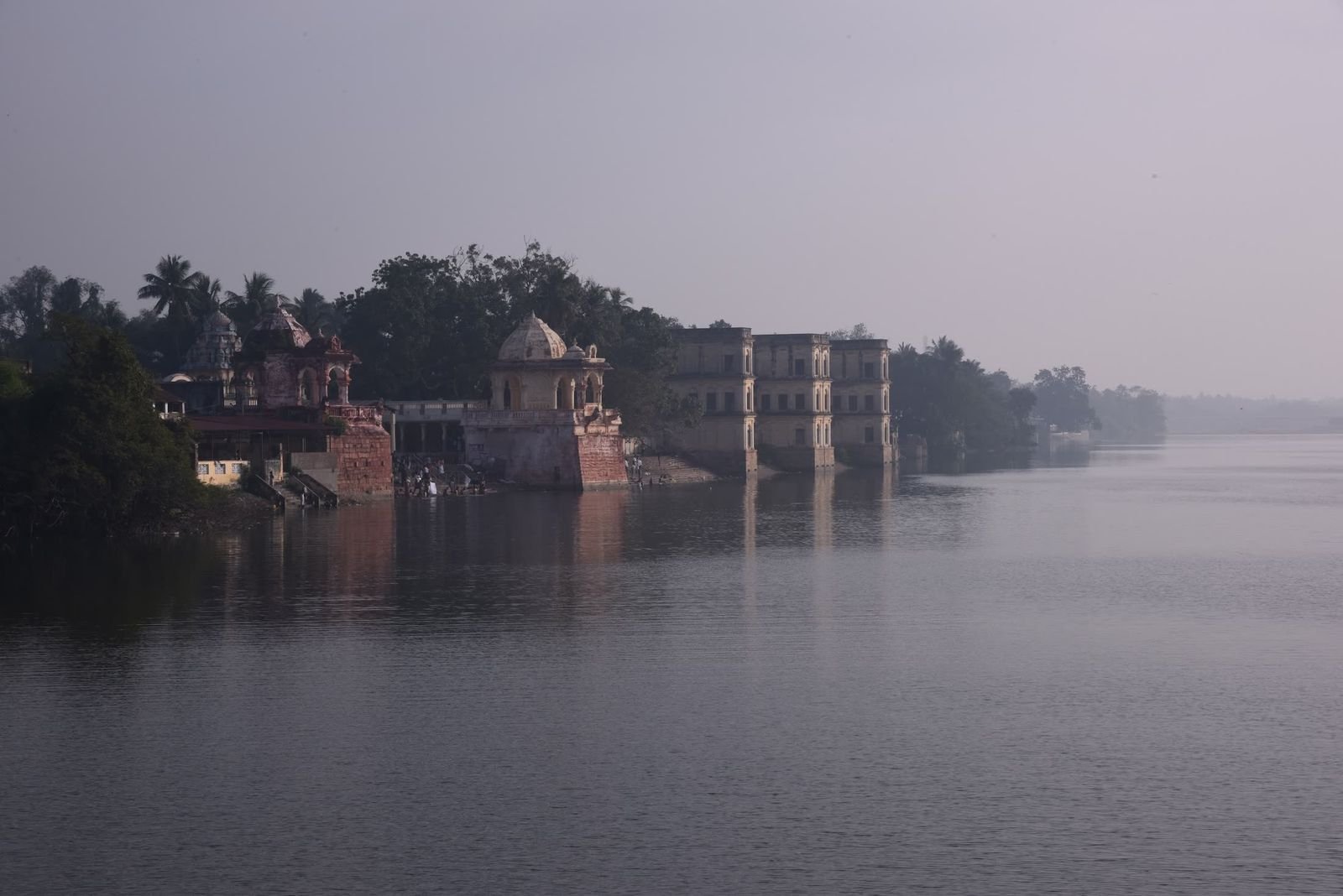
Thiruvaiyaru is not only a place where Thyagaraja Swamy composed some of his greatest works, but a venue where a multitude of musicians, including greatest among contemporary musicians get together to sing this great composer’s works in chorus.
Thiru means “Sacred” also name for God “Mahavishnu” who is called Thirumaal in Tamil and Goddess Lakshmi called Thirumagal.
Thiruvaiyaru is located at the confluence of five rivers namely Cauvery, Vadavar, Vettar, Kadamurutti, Vennar and was thus called a “Panchanada Kshetram” (the holy land of five rivers). For this very reason, Thiruvaiyaru is also known as “Dakshina Kashi”.
Lord Shiva rules the place in the name of Panchanadeeshwara, with his consort Dharmambika. Near the temple of Lord Shiva there is a street called “Thirumanjana Veedhi” where Ramabrahmam family settled in a house. Belonged to Aapasthamba Soothra Krishna Yajushakha, Bharadwaja Gothra, Smartha Mulakanadu Telugu Sect.
Sri Thyagaraja Swamy became a Sanyasi with the “Yoga Pattam” “Nada Brahmananda”.
Gu = Ignorance
Ru = Destroyer
Guru is one who destroys the darkness of ignorance and leads one to light. He is the visible form of Lord Sri Hari. His form is the basis for meditation and His lotus feet the basis of worship, His speech – root of mantras and His mercy - Moksha. As ‘Dakshinamurthy’, he is the sole teacher for the entire universe. There is no greater principle than the Guru – no Austerity, Penance or Spiritual knowledge greater than Him. For human beings scorched by the three fires, Adhyatmika, Adhi Daivika and Adhi Bhowthikam Guru is the Holy Ganges that puts out the fire. If Lord Sri Hari gets angry a Guru can protect us but there is no refuge if a Guru is annoyed.
As saint Kabir rightly said- the pristine golden qualities of a Sadguru cannot be elucidated fully even if you use the ocean as ink and entire earth as paper. To remember such a great saint is to raise ourselves from the mundane world. The Aradhana of Sri Thyagabrahma presents one such occasion. Since Thyagaraja spent most of his life like a sansyasi, and attained Mahasamadhi as a sanyasi, his aradhana is observed, unlike the other great composers of his time – Muthuswamy Dikshitar and Shyama Shastri, who were householders.
Thyagaraja himself says in his compostion ‘Guru Leka Yetuvanti… ‘a Guru alone will be able to protect the seeker by administering the medicine of spiritual initiation with love and lead him to enlightment.